

For decades, the adult entertainment industry operated in a financial gray zone. Many performers signed away their future earnings for a one-time cash payment, leaving them with little leverage when their content became a global hit. But that era is ending. As digital platforms mature and labor laws tighten, understanding financial rights has become the single most important skill for any creator entering this space today.
The difference between a sustainable career and a short-lived gig often comes down to three specific terms: royalties, residuals, and revenue shares. These aren't just accounting jargon; they are the mechanisms that determine whether you get paid once or forever. Getting these wrong can cost you thousands of dollars over the life of a single video. Let’s break down exactly how each works, where the traps are, and how to negotiate for what you’re actually worth.
The Core Financial Structures Explained
To navigate contracts effectively, you need to distinguish clearly between the three main types of ongoing compensation. They function differently, trigger at different times, and offer varying levels of security.
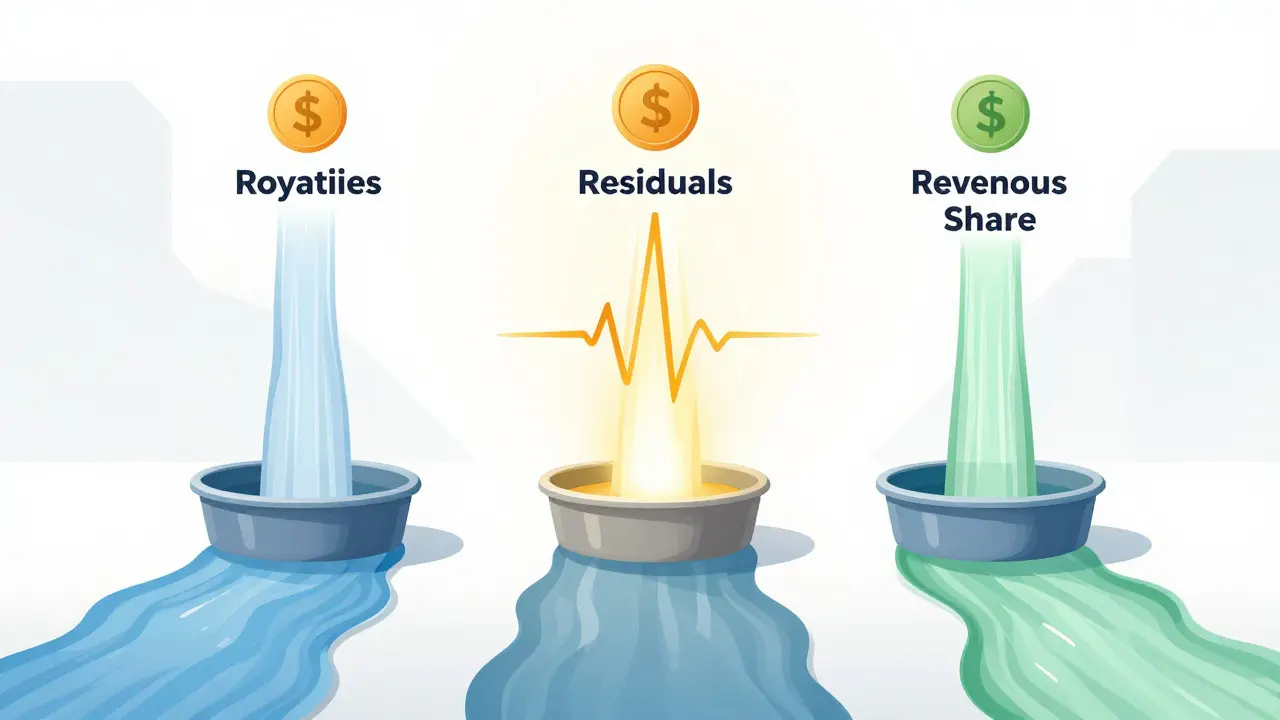
- Royalties: This is a percentage of the gross or net revenue generated by the sale of a specific product or license. If a studio sells your exclusive footage to a major streaming service, you might earn a royalty on that licensing fee. It is tied directly to the transaction volume.
- Residuals: Think of residuals as a re-broadcast fee. When content is aired again-whether on TV, cable, or a subscription platform-you earn a smaller, fixed amount or a reduced percentage. Residuals ensure you benefit from the longevity of your work without requiring new sales transactions.
- Revenue Share: Common in direct-to-consumer (DTC) models like OnlyFans or personal websites, this splits the profit from subscriptions or tips between the platform and the creator. Unlike royalties, which are often based on gross sales before costs, revenue shares are usually calculated on net income after processing fees and platform cuts.
Confusing these three is a common mistake. For instance, a contract might promise "residuals" but define them so narrowly that they only apply to traditional broadcast TV, ignoring digital streams entirely. Always ask: "What specific event triggers this payment?"
Why Unions Changed the Game
The landscape shifted dramatically with the rise of organized labor in the adult industry. Organizations like SAG-AFTRA and the Association of Video Producers have established minimum standards that used to be unheard of. Before these unions gained traction, it was standard practice for studios to pay a flat fee of $500-$1,000 for a scene, with no further obligation.
Today, unionized contracts guarantee:
- A minimum per-diem rate that scales with experience.
- Guaranteed residual payments for digital distribution.
- Health and pension contributions deducted from earnings.
- Clear definitions of "exclusive" vs. "non-exclusive" rights.
If you are working with a union shop, your baseline protections are higher, but the negotiation room is tighter. The rates are set by collective bargaining agreements. If you are non-union, you have more flexibility but bear all the risk. You must draft your own safety nets because there is no fallback agreement protecting your interests.
Negotiating Royalties: The Percentage Trap
When discussing royalties, the number matters less than the denominator. A 10% royalty on *gross* revenue is significantly better than a 10% royalty on *net* revenue. Net revenue subtracts production costs, marketing expenses, and third-party commissions. In many cases, high production costs can eat up so much of the "net" figure that the actual payout is negligible.
Here is a practical example. Imagine a studio produces a feature film costing $50,000 to make. They sell it to a distributor for $100,000.
- Gross Royalty Scenario: 10% of $100,000 = $10,000 to you.
- Net Royalty Scenario: Subtract $50,000 in costs from $100,000 sales = $50,000 net. 10% of $50,000 = $5,000 to you.
Always demand audit rights in your contract. This clause allows you (or an independent accountant) to inspect the studio's books to verify that the numbers reported to you are accurate. Without this, you are trusting the other side to do the math correctly. While audits are rarely exercised, the mere presence of the clause keeps reporting honest.
Residuals in the Digital Age
Traditional residuals were designed for television reruns. But in 2026, most consumption happens via subscription apps and VOD (Video on Demand). Do not accept a contract that defines residuals only for "linear broadcast." You need digital residuals.
Digital residuals typically fall into two categories:
- Per-Stream Payments: A tiny fraction of a cent for every time a user starts watching. This requires massive volume to be meaningful but provides passive income.
- Tiered Subscription Credits: A fixed amount paid when your content is included in a monthly subscription package. This is more predictable and often more lucrative for niche performers with loyal fanbases.
Check the expiration dates. Some contracts limit residual payments to five years. Others are perpetual. Perpetual is ideal, but if a producer resists, aim for a renewal clause that automatically extends the term unless either party gives notice. This prevents your earnings from suddenly stopping while your content remains available online.
Revenue Share Models for Direct-to-Consumer Creators
If you operate your own brand, revenue share is your primary income stream. Platforms like OnlyFans, Fansly, or your own website take a cut of everything you earn. The standard platform fee ranges from 10% to 30%. However, the hidden costs are often higher.
Consider the full stack of deductions:
- Platform Fee (e.g., 20%)
- Payment Processor Fees (e.g., 2.9% + $0.30 per transaction)
- Credit Card Interchange Fees (passed through to you)
- Marketing Costs (if you use paid ads)
A "70/30 split" sounds good until you realize that after processor fees and taxes, your actual take-home might be closer to 60%. To protect yourself, calculate your effective margin. If you charge $10/month for a subscription, and total deductions are $4, you keep $6. Now, factor in your time spent engaging with fans. If you spend two hours a day chatting, your hourly wage drops significantly. High engagement demands higher price points or stricter boundaries to maintain profitability.

Comparison of Compensation Models
| Feature | Royalties | Residuals | Revenue Share |
|---|---|---|---|
| Primary Use Case | Licensing & Sales | Reruns & Streaming | Direct Subscriptions/Tips |
| Payout Trigger | New Sale/License | Re-airing/Streaming | Monthly Recurring Revenue |
| Income Stability | Low (Variable) | Medium (Predictable) | High (Stable Base) |
| Control Level | Low (Studio Controlled) | Low (Platform Controlled) | High (Creator Controlled) |
| Best For | Actors in Studio Films | Veterans with Back Catalogs | Independent Brand Builders |
Common Contract Pitfalls to Avoid
Even with good intentions, contracts contain subtle language that can strip you of value. Watch out for these red flags:
- "All Rights Reserved": This phrase should appear in *your* favor. If the studio claims all rights, ensure they specify what those rights include. Does it cover AI-generated derivatives? Merchandise? Spin-off characters?
- Recoupment Clauses: Studios may deduct their production costs from your royalties before paying you. Ensure there is a cap on recoupment. Otherwise, you could work for free for years while the studio recoups its investment.
- Termination for Convenience: This allows the studio to end the deal without cause. If this exists, ensure you receive a final lump-sum payment for all past performance upon termination.
- Exclusivity Periods: Long exclusivity locks prevent you from working with competitors. Negotiate shorter windows (e.g., 6 months instead of 2 years) or carve-outs for social media appearances.
Protecting Your Long-Term Wealth
Your income is volatile. One viral month doesn't guarantee the next. Smart financial planning treats your earnings as capital for investment, not just lifestyle spending. Set aside a fixed percentage (at least 20-30%) for taxes immediately. The IRS does not wait for you to reconcile your accounts.
Build an emergency fund covering six to twelve months of living expenses. Because your income depends on market trends and algorithm changes, having a cash buffer reduces the pressure to sign bad deals during dry spells. Finally, consider diversifying. Use your residual income to invest in index funds, real estate, or even your own merchandise line. The goal is to decouple your survival from your daily performance output.
What is the difference between royalties and residuals?
Royalties are paid when a new copy of your work is sold or licensed to a third party. Residuals are paid when existing work is rebroadcast, streamed, or rerun. Royalties depend on new sales volume, while residuals depend on usage frequency.
Do I need a lawyer to review my contract?
Yes, especially for exclusive deals or high-value projects. A specialized entertainment lawyer can identify hidden clauses regarding recoupment, exclusivity, and digital rights that general lawyers might miss. The upfront cost is usually recoverable in the long run.
How long do residuals last?
It depends on the contract. Traditional TV residuals may last 5-7 years. Digital residuals can be perpetual if negotiated correctly. Always check the "term" section of your agreement to see if there is an expiration date or a renewal clause.
Is revenue share better than a flat fee?
For independent creators, revenue share is generally better because it aligns incentives. If your content performs well, you earn more. Flat fees cap your upside. However, flat fees provide guaranteed income regardless of performance, which is safer for beginners who haven't built an audience yet.
Can I get paid for AI-generated versions of my work?
This is an emerging area. Currently, most contracts do not explicitly cover AI derivatives. You should add a clause stating that any AI-generated content using your likeness or voice requires separate written consent and a new royalty payment.