

Key Takeaways
- IP-based blocking is the baseline but requires constant database updates to remain effective.
- GPS and browser-level geolocation offer higher precision for high-risk regions.
- Compliance isn't a one-time setup; it requires an automated pipeline for regional law updates.
- VPNs and proxies are the biggest loopholes; you need a detection layer to stop them.
The Core of Geoblocking Technology
At its simplest, geoblocking is the practice of restricting access to internet content based on the user's geographical location. For adult platforms, this is the primary shield against regional bans. Most platforms start with IP address filtering. When a user hits your server, your system looks at their IP and checks it against a database to see which country it belongs to. However, relying on a basic internal list is a recipe for disaster. You need a professional IP Intelligence Database like MaxMind or IP2Location. These services provide real-time updates because IP ranges shift constantly. If you use a static list from six months ago, you'll likely be letting in users from a state where your content is illegal while blocking legitimate users from a safe zone. This is a geoblocking adult platforms strategy that fails because it lacks dynamic data.Handling the VPN and Proxy Loophole
If you only block by IP, any teenager with a free VPN can bypass your entire compliance wall. This is where most adult sites fail their audits. A VPN (Virtual Private Network) allows a user to mask their true location by routing traffic through a server in a different country. To fight this, you need a proxy detection layer. High-end compliance setups use an "API-first" approach to check if an IP belongs to a known data center (like AWS or DigitalOcean) rather than a residential ISP. If a user is coming from a Google Cloud IP address, they aren't sitting in a living room; they're using a proxy. You have two choices here: hard-block all known VPNs or trigger a "Step-Up Authentication" process, such as requesting a phone number verified via SMS, which is much harder to fake with a VPN.
Advanced Location Verification: Beyond the IP
When the legal stakes are high-such as complying with strict age-verification laws in certain US states-IP addresses aren't enough. IP geolocation can be off by several miles, which is a problem when the law changes at a state border. This is where Geo-fencing and browser-level API requests come in. By using the HTML5 Geolocation API, your site can ask the user for their precise GPS coordinates. While many users will deny this request, you can make it a requirement for entry into high-risk zones. If the browser denies the request and the IP is suspicious, you can default to a "deny all" state.| Method | Accuracy | User Friction | Bypass Difficulty |
|---|---|---|---|
| IP Lookup | Low/Medium | Zero | Easy (VPN) |
| GPS/HTML5 | High | High (Permission pop-up) | Hard |
| SMS Verification | High | Medium | Very Hard |
| SIM-based Geo | Very High | Medium | Almost Impossible |
Building a Compliance Pipeline
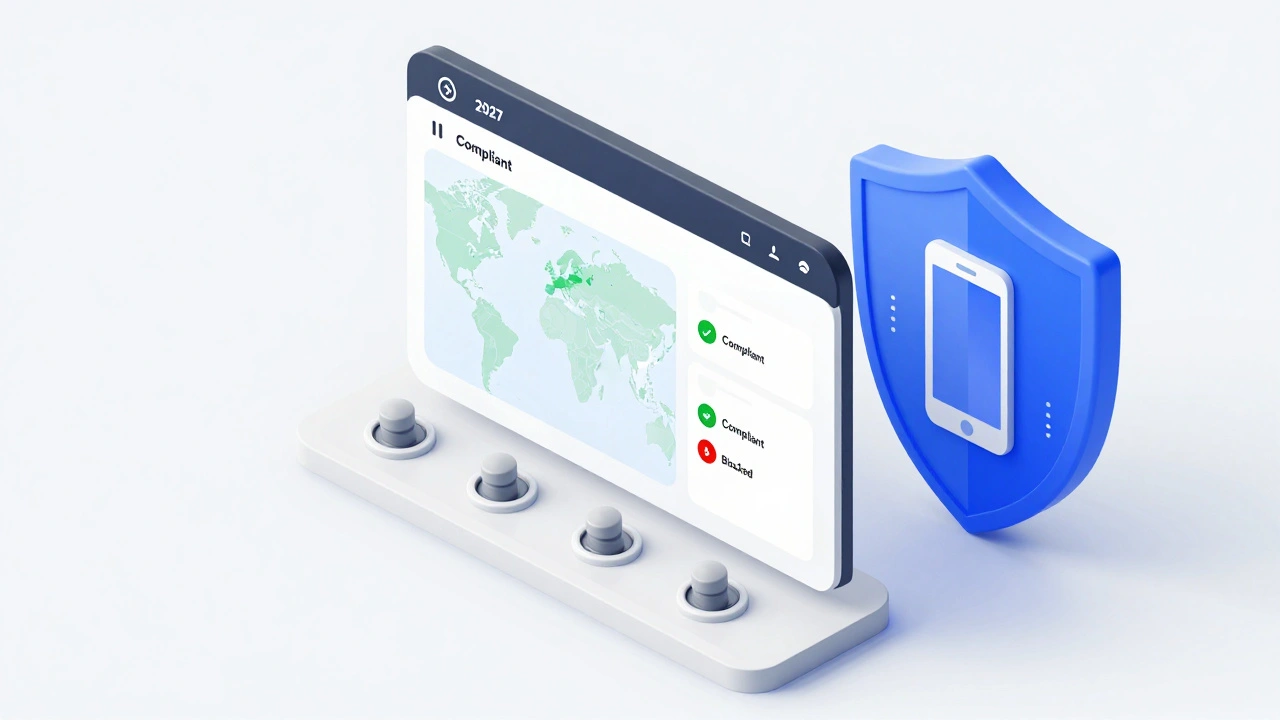
Compliance isn't just a technical hurdle; it's a legal one. You need a system that maps your technical blocks to specific Regional Regulations. For example, if a new law passes in Texas requiring specific age-verification methods, your system should allow you to toggle a "Strict Mode" for that specific region without affecting your users in Germany. This is best handled via a Configuration Management tool. Instead of hard-coding blocks into your app, use a centralized dashboard where your legal team can update "blocked zones" in real-time. This prevents the need for a full code deployment every time a court ruling changes in a different time zone. Your pipeline should follow this logic:- Detect incoming IP.
- Cross-reference with a real-time Geo-IP database.
- Check if the IP is a known proxy/VPN.
- Identify the specific legal requirements for that detected region (e.g., 18+ vs 21+).
- Serve either the content, a redirection page, or a verification wall.
The Danger of Over-Blocking
There is a temptation to just block entire countries to be safe. While this solves the legal problem, it kills your growth. The key is "Granular Blocking." Instead of blocking all of India or the US, you should aim for state-level or city-level precision. If you block too aggressively, you create a "dark zone" where legitimate customers can't reach you, and you essentially hand your market share to competitors who have a more surgical approach. The goal is to be "Compliant, not Absent." Use a Conditional Access Control system that allows users to prove their residency (via ID upload or credit card billing address) to override a false-positive IP block.Integrating with Payment Processors
Your geoblocking must talk to your payments. If your Payment Gateway (like Epoch or SegPay) detects a credit card from a region you've blocked on the frontend, the transaction will fail, and you might trigger a fraud alert. Ensure your KYC (Know Your Customer) process is synced with your geoblocking logic. If a user manages to bypass your IP block using a VPN but then tries to pay with a card from a restricted region, the payment failure should trigger an automatic account review. This creates a double-layered security mesh that catches the people your frontend filters missed.Is IP blocking enough to satisfy legal requirements?
In most cases, no. Courts and regulators increasingly view simple IP blocking as a "best effort" rather than a guarantee. For high-risk compliance, you need a combination of IP intelligence, VPN detection, and potentially third-party age verification services to prove you took "reasonable steps" to prevent unauthorized access.
How do I stop users from using VPNs to access my adult site?
The most effective way is to integrate an IP intelligence API that flags "Anonymous Proxies" or "Data Center IPs." When the system detects a VPN, you can either block the connection entirely or force the user to complete a more rigorous identity check, such as a mobile phone verification linked to a physical SIM card.
What is the difference between geoblocking and geo-fencing?
Geoblocking is usually based on IP addresses and is used to restrict access to entire countries or regions. Geo-fencing is much more precise, often using GPS or Wi-Fi signals to create a virtual boundary around a specific physical area. In the adult industry, geoblocking is used for national laws, while geo-fencing might be used for highly specific local ordinances.
Will a CDN like Cloudflare help with geoblocking?
Yes, CDNs can handle the first layer of blocking at the edge, which means the request never even reaches your origin server. This saves bandwidth and improves speed. However, CDN blocking is often less granular than a dedicated compliance engine, so you should use the CDN for broad country blocks and your own backend for state-level or complex compliance logic.
How often should I update my IP databases?
IP ranges change daily. If you are using a manual import, you should update at least weekly. However, the gold standard is using a real-time API. This ensures that a user who just got a new IP address from their ISP isn't accidentally blocked, and a new VPN range is caught immediately.