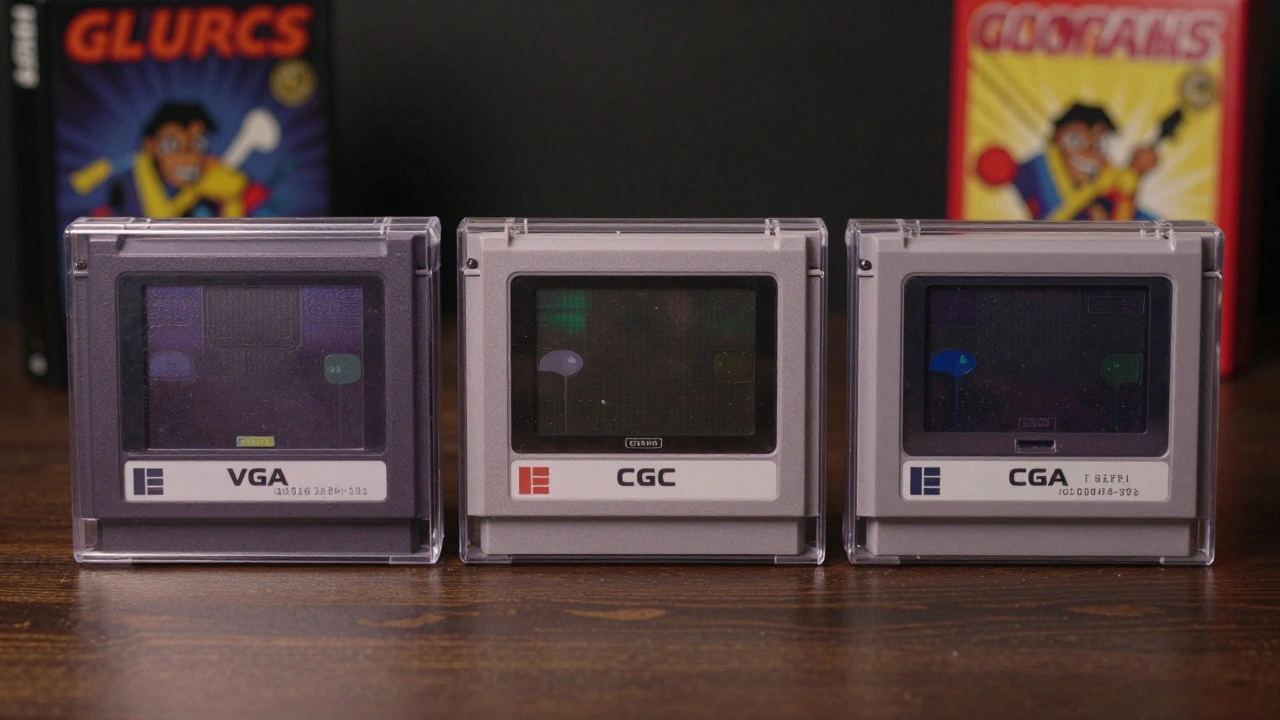

When you buy a sealed copy of Super Mario Bros. from 1985, you’re not just buying a game-you’re buying a piece of history. But how do you know it’s truly in mint condition? That’s where video game grading comes in. Companies like VGA, CGC Video Games, and CGA inspect every scratch, fold, and sticker mark to assign a numerical score. That score decides whether a game sells for $200 or $20,000. But here’s the problem: there’s no single standard. Each grading company uses its own scale, its own rules, and its own process. And with collectors spending millions, the lack of uniformity is becoming a serious bottleneck.
How Grading Works Today
Right now, three major players dominate the market. VGA uses a 100-point scale split into Gold, Silver, and Bronze tiers. A game graded 95+ gets sealed in a hard plastic case with a label that says it’s nearly perfect. CGC Video Games uses a simpler 10-point scale, with letter grades like A+ or B- to show how clean the seal is. CGA offers both a 100-point scale and a 10-point version, but insists they’re measuring the same thing-just with different numbers.
The process isn’t magic. It’s methodical. A junior grader with at least two years of experience checks every corner of the box, the cartridge, the manual, even the shrink wrap. They note every tiny tear, every faded color, every sticky residue. Then a senior grader-someone with five to eight years under their belt-reviews the assessment. If they disagree, the game gets regraded. Only after that final review is it locked into an acrylic case with a serial number and a hologram.
Costs vary. VGA charges $90 for games valued up to $5,000. For rare titles worth $100,000? You’re looking at $125. That’s not cheap, but for collectors, it’s worth it. A game graded 9.8 by CGC can sell for triple what an ungraded copy goes for. The market is real. In 2024, a sealed The Legend of Zelda from 1986 sold for $87,000 after being graded 9.6 by CGC. That’s not an outlier-it’s the new normal.
The Fragmented System
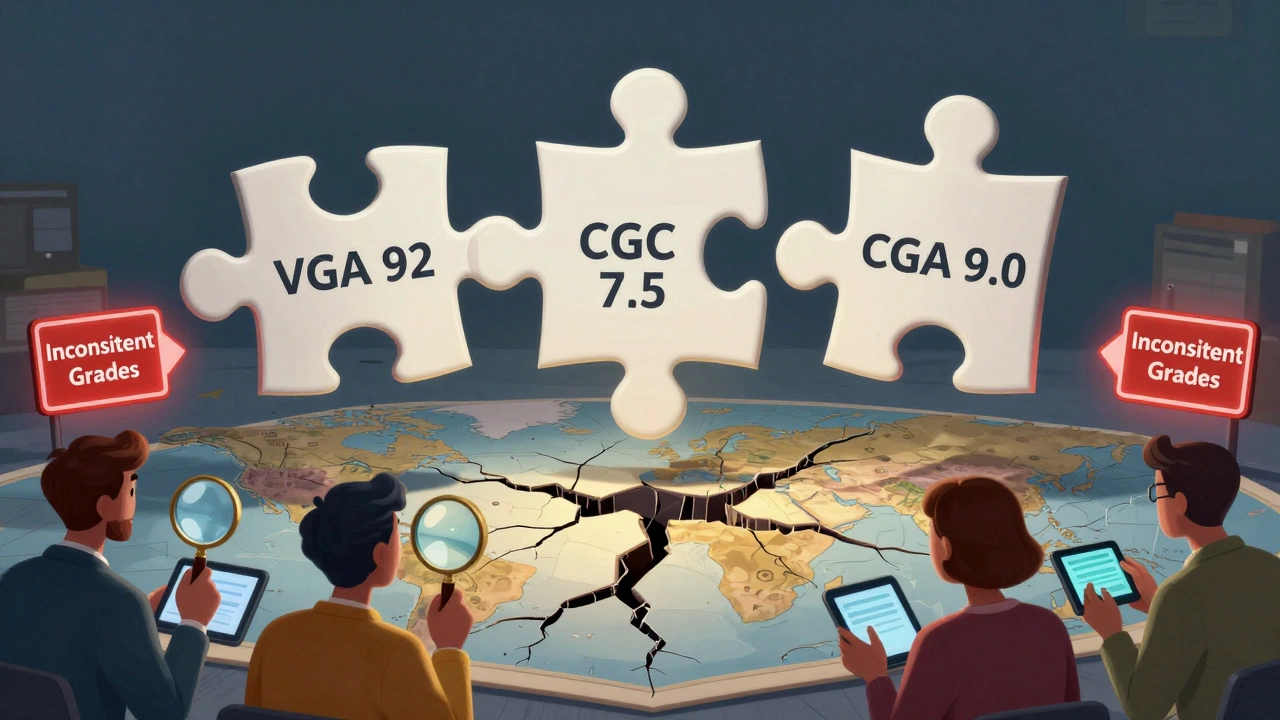
Here’s where things get messy. If you send the same game to VGA, CGC, and CGA, you’ll likely get three different grades. Not because one is wrong-but because each uses a different scale, a different interpretation of what “mint” means.
Imagine you’re selling a game online. A buyer sees a VGA 92 and thinks it’s great. But another buyer checks CGC’s scale and realizes that a 92 on VGA is roughly equivalent to a 7.5 on CGC’s 10-point system. Now they’re confused. Or worse-they think you’re trying to trick them. That’s not just bad for trust. It’s bad for sales.
And there’s no official rulebook. No governing body. No industry-wide standard. Each company sets its own criteria. CGC might consider a tiny crease in the manual a downgrade. VGA might overlook it if the box is otherwise flawless. CGA might rate it higher because their scale is looser. Collectors are left guessing. And when you’re spending $10,000 on a single cartridge, guessing isn’t an option.
Why Standardization Is Inevitable
The market is growing fast. More people are collecting games. More auctions are happening. More online marketplaces are listing graded copies. But without a common language, this growth hits a wall.
Think about trading cards. In the 1990s, there were dozens of grading companies. Beckett, PSA, SGC-all had their own scales. Collectors couldn’t compare values. Then PSA became the dominant standard. Today, a PSA 10 card is the gold standard. It’s not because PSA was perfect-it’s because the market chose it. And now, even if you get your card graded by another company, they’ll often say, “This is equivalent to a PSA 9.”
The same thing is starting to happen with video games. CGC has the most name recognition. VGA has the most detailed tiers. CGA is trying to bridge the gap with dual scales. But no one’s forcing alignment. And without alignment, the market stays fragmented.
Some collectors are already pushing for change. Reddit threads are full of people asking: “Why can’t we just agree on one scale?” Forums are debating whether a 95 on VGA should equal a 9.5 on CGC. There’s even a petition on Change.org with over 12,000 signatures calling for a unified grading standard.
What Regulation Could Look Like
Regulation doesn’t mean government stepping in. It means industry-wide agreements. Think of it like the ESRB or PEGI for content ratings-but for condition.
What if the three major graders sat down and agreed on a single scale? Say, a 10-point system with clear definitions: 10 = flawless, 9.5 = near mint with one minor flaw, 9 = light wear, etc. They could still keep their branding, their cases, their logos-but the grade itself would mean the same thing everywhere.
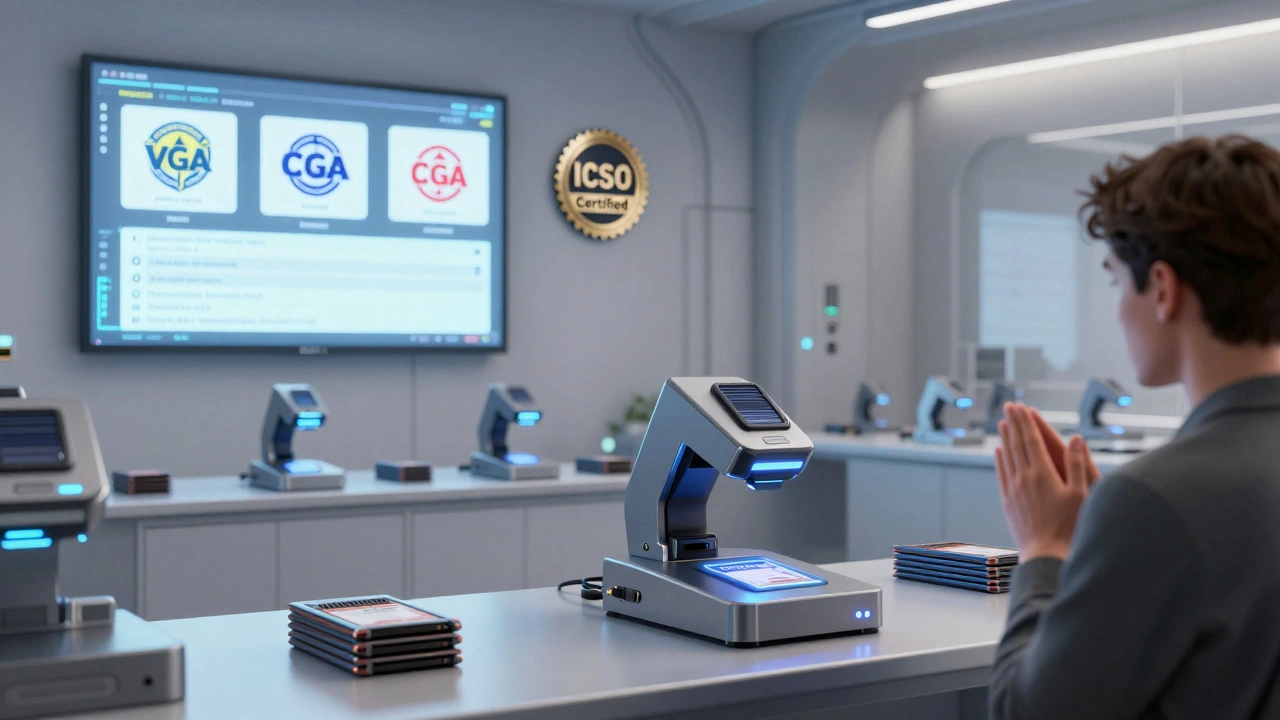
Or maybe a neutral third party-a nonprofit like the International Collectibles Standards Organization-could step in. It wouldn’t grade games. It would certify which grading companies follow the rules. Like UL for electronics, or ISO for quality control. If a company passes the audit, it gets a seal of approval. Buyers know: “If it says certified by ICSO, I can trust the grade.”
Some might say, “That’s too corporate.” But look at the alternative. Without standardization, fraud becomes easier. A seller could claim a game is “VGA 98” when it’s actually a 90. Buyers have no way to verify. And as AI tools get better at faking photos, the risk grows.
Technology’s Role
Blockchain is already being tested. One startup in Austin is using blockchain to store grading records. Each sealed game gets a digital twin-a unique NFT linked to its physical case. The NFT holds the original grading report, photos, and even the grader’s signature. If someone tries to fake a certificate, the blockchain shows the real one.
It’s not perfect. Blockchain doesn’t fix the scale problem. But it fixes the trust problem. Even if two companies use different scales, if both store their grades on a public ledger, buyers can cross-check. That’s a step toward transparency.
Another idea? AI-assisted grading. Companies are experimenting with machine vision to scan games for scratches, discoloration, and wear. The AI doesn’t make the final call-it just flags issues a human might miss. A grader still approves the grade. But now, the process is more consistent. Less subject to human error.
What’s Holding It Back
Big companies don’t want to give up control. VGA has built its brand around its detailed tiers. CGC has its reputation. CGA is trying to innovate. If they all agree on one scale, who wins? Who loses? And who pays for the transition?
Collectors are split too. Some love the current system. They like the drama, the competition, the mystery. Others just want to know what they’re paying for. The younger generation-those buying games on eBay and StockX-don’t care about the history. They want clarity.
And then there’s the cost. Rebuilding a grading system, retraining graders, updating databases, rebranding cases-it’s expensive. Who funds it? The companies? The collectors? A consortium?
The Path Forward
The future isn’t about one company winning. It’s about collaboration.
Here’s what could happen in the next five years:
- CGC, VGA, and CGA jointly release a unified grading scale by 2027.
- A nonprofit certification body is formed to audit grading practices.
- Major auction houses like Heritage Auctions and eBay only accept certified graded games.
- Insurance companies start requiring certified grades for high-value policies.
- AI scanning tools become standard in every grading center.
This isn’t science fiction. It’s happening in trading cards, watches, and sneakers. Video games are next. The money is too big to ignore. The demand for trust is too strong to resist.
If you’re a collector, don’t wait for someone else to fix it. Talk to your community. Ask your favorite grading company: “What are you doing to standardize?” Vote with your wallet. Buy from companies that support transparency. Push for open data. Demand consistency.
The future of graded video games isn’t about who grades the best. It’s about who makes grading fair for everyone.
What’s the difference between video game grading and content ratings like ESRB?
Video game grading evaluates the physical condition of the game-box, cartridge, manual, shrink wrap. Content ratings like ESRB, PEGI, or USK classify games based on age-appropriate content-violence, language, nudity. They serve completely different purposes. One tells you if a game is mint; the other tells you if it’s suitable for a 12-year-old.
Can I trust a game graded by a lesser-known company?
Not unless you know their standards. Some small graders use looser criteria, inflate grades, or skip the double-check process. Stick with VGA, CGC, or CGA until a certification body like an ICSO emerges. Even then, check their public grading logs. Reputable companies let you search their database by serial number.
Will blockchain replace physical grading?
No. Blockchain doesn’t replace the physical inspection-it enhances it. You still need someone to examine the game, take photos, and seal it. Blockchain just stores the proof so no one can forge a grading report. Think of it like a digital receipt for your graded game.
Why don’t all grading companies use the same scale?
Because they’re businesses, not charities. Each has built its brand around its own system. VGA’s 100-point scale appeals to collectors who want granular detail. CGC’s 10-point scale is simple and familiar. Changing would mean losing their identity-and possibly their market share. But as demand grows, collaboration is becoming unavoidable.
Is the grading industry regulated by any government?
No. There’s no federal or international agency overseeing video game condition grading. It’s entirely self-regulated. That’s why standardization efforts are so important. Without rules, the market is vulnerable to inconsistency, fraud, and confusion. The best protection right now is buyer awareness and industry cooperation.