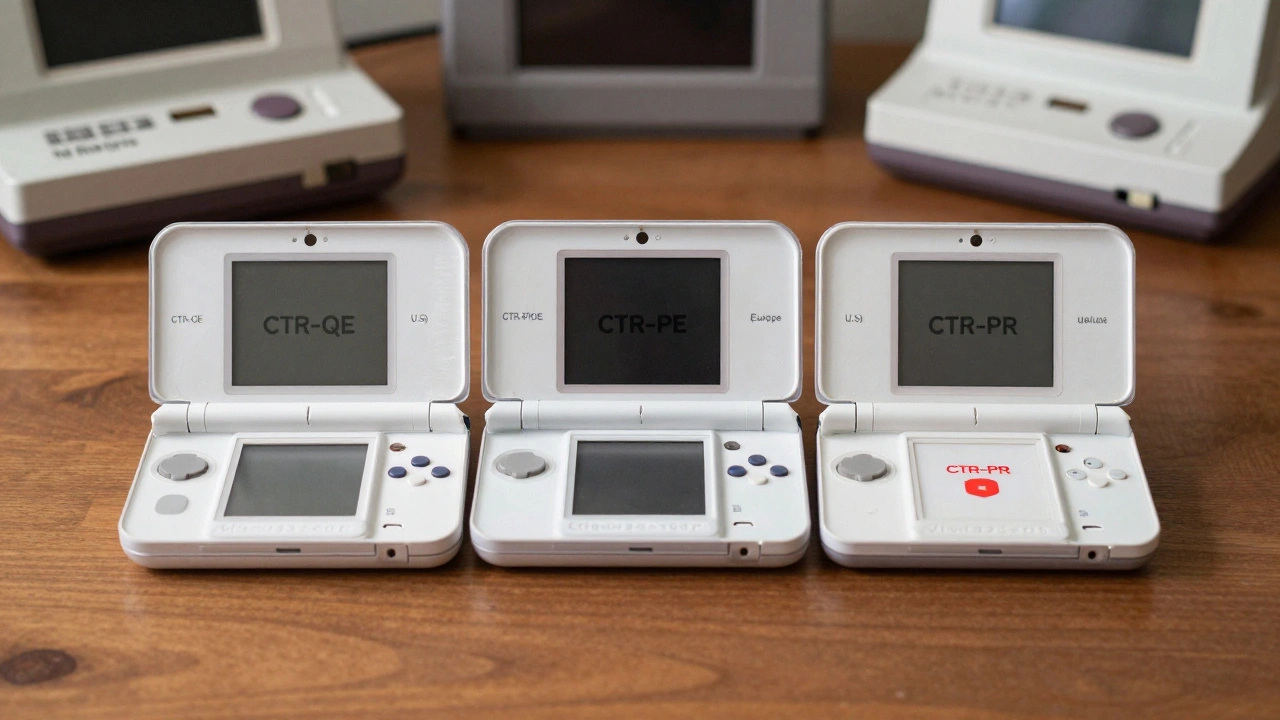

When you’re building a collection of Nintendo DS and 3DS games, the first thing you notice isn’t the box art or the cartridge design-it’s the region code stamped on the label. That tiny bit of text-"CTR-QE" for the U.S., "CTR-QE" for Europe, or "CTR-PR" for Japan-can mean the difference between a game you can play and one that sits on the shelf, untouched. Region locking isn’t just a technical detail. For collectors, it’s a gatekeeper that shapes entire markets, determines rarity, and drives prices for sealed games.
What Region Locking Actually Means
Not all Nintendo handheld games are locked. The original Nintendo DS (not DSi) lets you play any cartridge, no matter where it came from. If the product code starts with "NTR", it’s region-free. That includes classics like The Legend of Zelda: Phantom Hourglass and Super Mario 64 DS. But once you step into the DSi or 3DS era, everything changes. The 3DS and DSi use firmware-level region locking. That means it’s not a physical barrier in the hardware-it’s software. Nintendo could have turned it off with a patch. They chose not to. Why? Publishers wanted control. Japan gets exclusive titles like Fire Emblem: New Mystery of the Emblem or Animal Crossing: New Leaf - Welcome amiibo with unique events. Europe gets different bundles. The U.S. gets its own version of games with altered content. If you could swap regions freely, those markets would bleed into each other. Sales would drop. So Nintendo locked it down.How to Spot a Region-Locked Game
You don’t need to guess. The product code tells you everything. Look at the back of the cartridge. If it starts with "NTR", it’s region-free. If it starts with "TWL" (for DSi) or "CTR" (for 3DS), it’s locked.- U.S. games: End in "-QE" (e.g., CTR-QE)
- European games: End in "-PE" (e.g., CTR-PE)
- Japanese games: End in "-PR" (e.g., CTR-PR)
Why Sealed Japanese Games Are So Valuable
Here’s where collecting gets real. Japan gets exclusive titles you can’t find anywhere else. Monster Hunter 3G (the 3DS version) had three unique monsters only available in Japan. Fire Emblem: Awakening had a bonus DLC map in Japan that never made it to the West. Animal Crossing: New Leaf had exclusive seasonal events tied to Japanese holidays. These aren’t just minor differences. They’re entire game experiences locked behind a region barrier. So sealed copies of these games? They’re rare. And collectors who want them? They have two choices: buy a Japanese 3DS, or region-change their console. But here’s the catch: region-changing your 3DS breaks your Nintendo Network ID. Once you do it, you lose access to the eShop. No more updates. No more digital purchases. And if you ever try to use Pokemon Bank-a service that stores your Pokemon from Gen 5 and 6-you’re locked out. You can’t transfer your save data. You can’t play online. You’re stuck with physical cartridges only. And if you mess up the region change? You can brick your console. There’s no undo button. You need a NAND backup made before the change. Most collectors don’t have one. So they don’t risk it. That means sealed Japanese games are worth more-not because they’re prettier, but because they’re unusable on most consoles. A sealed copy of Fire Emblem: Awakening in Japanese might sell for $150. The U.S. version? $50. Why? Because the U.S. version works on 90% of 3DS systems. The Japanese one? Only if you own a Japanese console or are willing to break yours.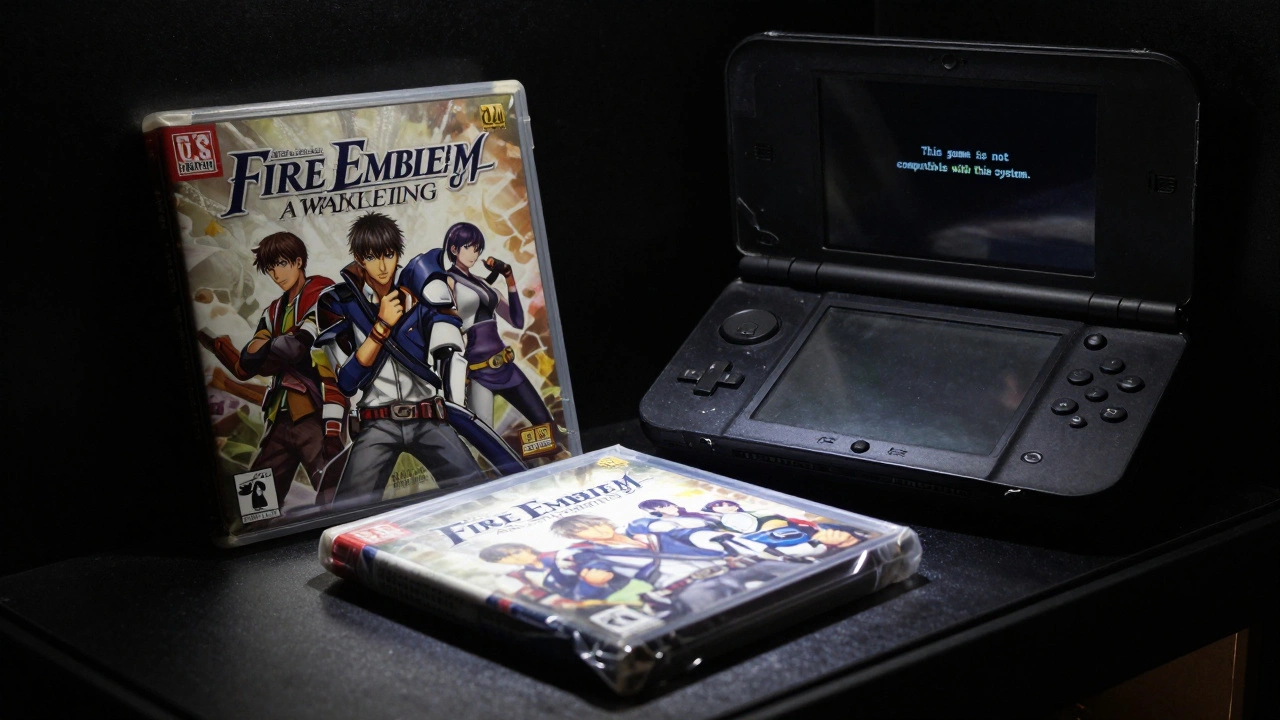
The Collector’s Dilemma: One Console or Many?
You can’t collect everything with one system. If you want to play every game, you need three 3DS consoles: one for Japan, one for the U.S., one for Europe. That’s expensive. A used 3DS costs $50-$80. Three of them? That’s $150-$240 before you even buy a game. Most collectors pick one region and stick to it. U.S. collectors focus on American releases. Japanese collectors focus on Japanese exclusives. Europeans? They’re stuck in the middle-some games never come to Europe at all. So they import. That’s why sealed Japanese DS and 3DS games are so sought after. They’re not just rare. They’re inaccessible. And that makes them valuable.What Drives Sealed Game Prices
Region locking is just one factor. Here’s what else matters:- Production numbers: Games with low print runs-like Professor Layton and the Diabolical Box with a promotional card-are worth more.
- Box condition: A sealed game with a creased box or faded colors loses 30-50% of its value.
- Authenticity: Fake cartridges exist. Look for the Nintendo logo on the cartridge, the correct sticker placement, and the right color of the plastic. A fake sealed game is worth nothing.
- Exclusives: Games with bonus items (like the Super Mario 3D Land box with a 3D glasses insert) sell for double.
What You Should Do as a Collector
If you’re serious about collecting sealed DS and 3DS games:- Decide which region you want to focus on. Stick to it. Don’t try to collect everything.
- Buy games from trusted sellers. Check eBay, Reddit’s r/DS3DS, or collector forums. Look for photos of the actual box, not stock images.
- Never region-change your console. The cost isn’t worth it. You lose eShop access, Pokemon Bank, and risk bricking your device.
- Store games in climate-controlled spaces. Heat and humidity ruin shrink wrap and box colors.
- Use a grading service like Wata Games if you’re investing serious money. They’ll authenticate, grade, and seal the game in a tamper-proof case.
Final Thought: The Hidden Market
Region locking didn’t just protect sales. It created a hidden collector economy. Japanese games are the dark horse of the 3DS market. They’re not more beautiful. They’re not more fun. But they’re the only way to experience some of the most unique games ever made for the platform. And that’s why sealed Japanese copies sell for three times the price of their Western counterparts. It’s not about the game. It’s about access. And in collecting, access is everything.Can I play a Japanese 3DS game on my U.S. 3DS without region changing?
No. Region locking is enforced at the firmware level. A Japanese game will not boot on a U.S. 3DS. The system will display an error message stating the game is incompatible. The only way to play it is to use a Japanese 3DS console or perform a region change, which comes with major drawbacks.
Does region locking apply to DS games too?
Only to DSi-enhanced games. DS games with product codes starting with "NTR" are region-free and work on any DS or 3DS. But games with "TWL" codes (designed for DSi features) are region-locked. Most popular DS games, like Pokemon Platinum or Super Mario DS, are region-free. The locking mainly affects DSi and 3DS titles.
Is it safe to region-change my 3DS to play imported games?
Technically, yes-but not for collectors. Region changing permanently disables your Nintendo Network ID and locks you out of the eShop, Pokemon Bank, and system transfers. You also can’t uninstall custom firmware without a NAND backup. Most collectors avoid it because the cost-losing digital access-is higher than the benefit.
Why are Japanese sealed games worth more than U.S. ones?
Because they’re often exclusive, harder to obtain, and unplayable on most consoles. A sealed copy of Fire Emblem: Awakening in Japanese has unique content not found in the U.S. version. Since most collectors don’t own a Japanese 3DS, demand for these sealed copies is high, and supply is low. That drives prices up.
Can I still use Pokemon Bank if I region-change my 3DS?
No. Pokemon Bank requires an active Nintendo Network ID and eShop access. Region changing disables both. Even if you delete your account, the system still blocks access to services tied to the original region. You’ll lose all your stored Pokemon and won’t be able to transfer them to newer games.
What’s the best way to store sealed games for long-term value?
Keep them in a cool, dry place away from sunlight. Use acid-free storage boxes. Avoid plastic sleeves that can stick to the box. Never stack heavy items on top. For high-value games, consider professional grading from Wata Games or VGA, which authenticates and seals the game in a tamper-proof case.