

Adult entertainment businesses aren’t just about performances-they’re caught in a web of local laws that change faster than you can check your phone. In 2026, what’s legal in Nevada might land you in jail in Texas. And it’s not just strip clubs. It’s lap dances, private rooms, cabarets, webcam studios, and even adult toy shops. Each state, and often each city, has its own rules. No two places are the same.
What Counts as Adult Entertainment?
There’s no federal definition. That means states decide for themselves what counts. In California, a business is classified as adult if it features live nudity, sexual acts, or explicit video content visible to the public. In Florida, it’s about whether the establishment has a primary focus on sexual stimulation. In New York, it’s not the act-it’s the zoning. A bar with occasional topless dancers isn’t automatically an adult business. But if it has more than three such performances a week? That triggers licensing.
Even things you wouldn’t expect are regulated. In Chicago, selling adult toys in a store without a special permit is a misdemeanor. In Georgia, webcam studios must register with the county clerk. In Ohio, private dance rooms require a separate license from the main venue. It’s not just about what you show-it’s about how, where, and who you serve.
Where It’s Tight: The Strictest States
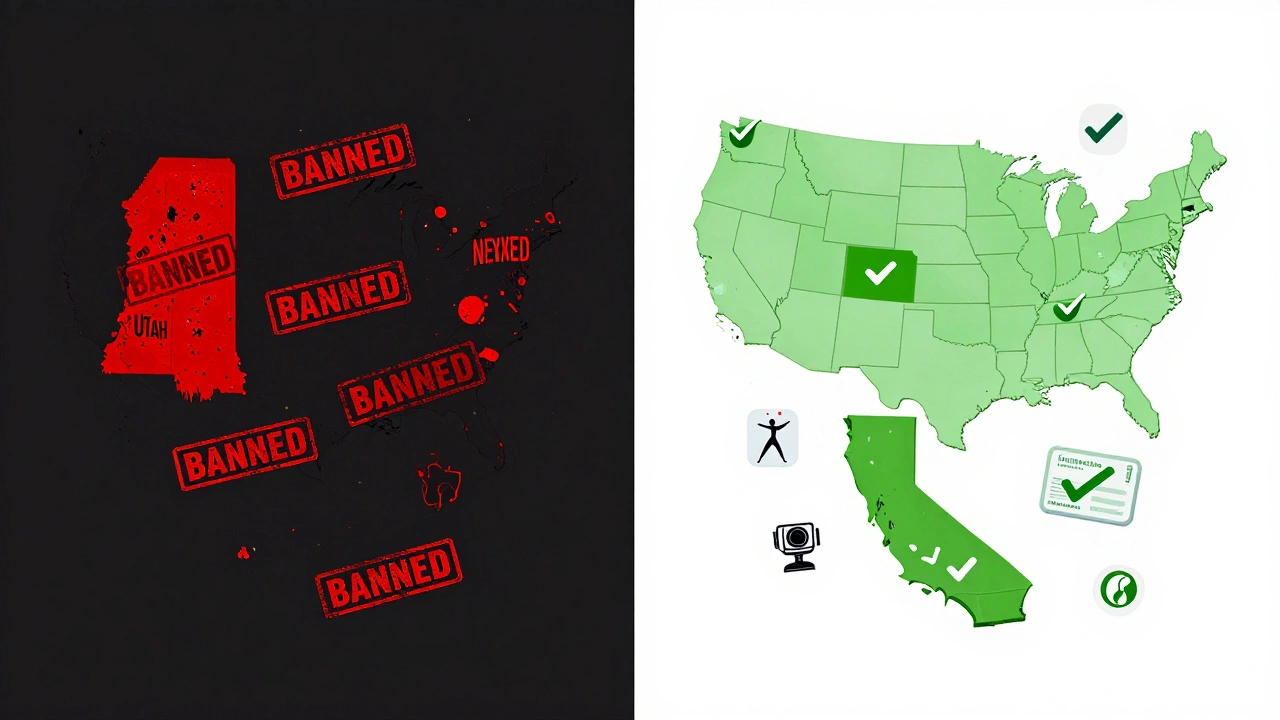
Some states have made it nearly impossible to operate legally. Texas leads the list. In cities like Houston and Dallas, adult businesses must be at least 1,000 feet from schools, churches, parks, and even residential zones. That leaves very few spots open. In 2025, the state passed a law banning any establishment where performers are not fully clothed during customer interaction. That killed most private dance rooms.
Mississippi has a total ban on public nudity. No exceptions. Even in private clubs. That means no topless dancers, no thong-only outfits, no body paint that reveals more than skin. Violations are felony charges. And the state doesn’t just enforce the law-they track performers. Every dancer must register with the state police and carry a photo ID card at all times while working.
Utah is another extreme. The state requires all adult businesses to be licensed by the Attorney General’s office. No local permits. Just state. And the state requires background checks for everyone who works there, including bartenders and bouncers. In 2024, over 400 applicants were denied because of prior offenses-even minor ones from over a decade ago.
Where It’s Looser: The More Permissive States
Not all states are like that. Nevada is the most open. Las Vegas and Reno allow fully nude performances, private dances, and even customer contact in designated areas. The only rule? No sexual acts. That’s it. No zoning restrictions between businesses and schools. No mandatory background checks for staff. The state just requires a simple business license and a $500 annual fee.
California has a mixed picture. While some cities like Los Angeles have strict rules, others like San Francisco allow almost anything as long as it’s consensual and not in view of minors. In 2025, San Francisco passed an ordinance that removed the 500-foot buffer from schools. Now, adult businesses can operate next to community centers-so long as they install opaque windows and have no outdoor signage.
Washington State is also relaxed. Portland, Oregon, where I live, has no state-level restrictions on adult entertainment. Local cities can set rules, but they can’t ban businesses outright. In Portland, you can have a fully nude dancer in a club as long as the venue has a liquor license and doesn’t serve alcohol to anyone under 21. No registration, no background checks, no special permits. Just follow the same rules as any other bar.
The Hidden Rules: Zoning, Licensing, and Enforcement
Most people think it’s about what’s performed. But the real battle is over zoning. Cities use zoning laws to push adult businesses into industrial areas or away from neighborhoods. In Atlanta, you can’t open an adult business within 1,500 feet of any public park, library, or daycare. That’s over 80% of the city. In Denver, the rule is 1,200 feet from any residential zone. That means you can’t open near a single-family home-even if it’s on the edge of town.
Licensing is another minefield. In New Jersey, you need three separate permits: one from the state, one from the county, and one from the city. Each costs over $1,000. And you can’t get them until you’ve held a public hearing. That process takes 60 to 90 days. In contrast, Nevada only requires one permit, and it’s issued the same day if paperwork is correct.
Enforcement is uneven. In some places, police ignore violations unless someone complains. In others, they do surprise inspections every month. In Michigan, inspectors show up unannounced and check for things like whether the lighting is too dim, if dancers are wearing the right amount of fabric, or if the music volume exceeds 85 decibels. One club in Detroit was shut down for 14 days because a dancer’s outfit had a 2-inch gap in the back.
What’s Changing in 2026?
2026 is seeing a wave of new laws. Florida is moving to ban all private dance rooms by July. California is requiring all performers to have health insurance provided by the employer. New York City is testing a new system where all adult businesses must install cameras in public areas-not to record customers, but to monitor for underage entry. And in Arizona, a new law requires all adult businesses to report monthly financial records to the state tax office, even if they don’t pay taxes.
Some states are relaxing. Colorado just removed its 500-foot buffer from schools. Illinois passed a law that says adult businesses can’t be denied a license based on past convictions that aren’t related to sexual offenses. And in Oregon, lawmakers are considering removing the requirement for adult businesses to have separate entrances from the main building-a rule that’s been around since the 1990s.
What You Need to Know If You’re Operating One
If you run or plan to open an adult business, here’s what you must do:
- Check your state’s definition of adult entertainment-don’t assume it’s the same as your neighbor’s.
- Find out your city’s zoning map. Many cities have online tools to check distance from schools and parks.
- Apply for permits early. Some take 3 to 6 months.
- Train your staff. In states like Mississippi, even asking a customer for a tip can be considered solicitation.
- Keep records. In states like Arizona and New York, you must keep logs of all transactions, performer hours, and customer complaints.
- Know your local police attitude. Some departments are hands-off. Others have full-time vice units.
One owner in Nashville told me he spent $18,000 on legal fees just to get his club licensed. He thought it was a bar with dancers. Turns out, the city classified it as a "sex-oriented business" because one dancer wore a pasty. He had to restructure the entire venue-change the lighting, install a new sound system, and even move the bar.
What’s Not Legal (Even If It Seems Okay)
Just because something feels normal doesn’t mean it’s allowed. Here are common mistakes:
- Using a webcam studio from your home-many states require a commercial address.
- Letting a minor enter the venue-even if they’re with a parent. In most places, it’s illegal for anyone under 18 to be inside, period.
- Accepting cash-only payments to avoid taxes. The IRS tracks these businesses closely.
- Using social media to advertise. Some states ban any online promotion of adult services.
- Hiring someone without a background check. In states like Utah and Mississippi, even a DUI from 10 years ago disqualifies you.
And here’s a twist: in 2026, three states-California, New Jersey, and Maryland-started requiring adult businesses to offer mental health resources to performers. It’s not a mandate to pay for therapy, but you must post a hotline number and have a pamphlet available. Failure to do so can lead to license suspension.
Final Reality Check
There’s no national standard. There won’t be. What’s legal today might be illegal tomorrow. A business that opened in 2020 in Ohio is now shut down because the city changed its zoning map. A dancer who worked in Texas for five years moved to Oregon and got a job right away-no questions asked.
The only thing that stays the same? Always verify. Don’t rely on what you heard. Don’t trust a friend’s experience. Go to your state’s attorney general website. Look up the local city code. Call the licensing office. Ask for the exact statute number. Write it down. Keep a copy.
Because in this business, ignorance isn’t an excuse. It’s a liability.
Are adult entertainment businesses illegal in any U.S. states?
Yes. Mississippi has a total ban on public nudity in any venue, making most adult entertainment operations illegal. Utah and Texas also severely restrict operations with zoning laws and licensing that effectively shut down most businesses. Some counties in Alabama, Arkansas, and South Carolina have outright bans on adult businesses within city limits.
Can I open an adult business from my home?
In almost all states, no. Most require a commercial zoning designation, which excludes residential areas. Even webcam studios must operate from a business address. Some states, like California and Oregon, allow home-based operations only if they don’t involve live performers or customer interaction. But even then, you may need a home occupation permit and must avoid any public signage.
Do I need a background check to work in an adult club?
It depends on the state. In Utah, Mississippi, and New Jersey, all employees-including bartenders and security-must pass a background check. In Oregon, California, and Nevada, background checks are not required unless you’re handling money or managing the business. Performers themselves are rarely subject to checks unless the state has specific performer registration laws.
What happens if I violate adult entertainment laws?
Penalties vary. Minor violations-like improper lighting or missing signage-can lead to fines of $500 to $5,000 and temporary closure. Major violations-such as allowing minors on site, public nudity where banned, or operating without a license-can result in permanent shutdown, criminal charges, and even jail time. Repeat offenders often face felony charges and loss of business licenses for life.
Can I advertise adult services online?
Many states restrict or ban online advertising. California, New York, and Florida prohibit using social media, Google Ads, or search engines to promote adult venues. Some states allow it only if the ads don’t mention nudity, sexual acts, or private dances. Always check your state’s advertising laws before posting anything online.