
When you’re looking to sell your old video games, whether it’s a boxed copy of a retro title or a stack of unused digital skins, two names keep popping up: eBay and Gameflip. Both let you turn unused gaming gear into cash, but they operate like two different worlds. One is a massive, decades-old general marketplace. The other is a lean, gaming-only platform built for digital items. If you care about how much you actually take home - not just the listing price - you need to know the real difference between them.
How Much Do You Actually Keep?
eBay charges a flat 10% fee on the final sale price. That’s it. No upfront listing costs if you sell fewer than 50 items a month. Sounds simple, right? But here’s the catch: that 10% doesn’t include shipping. You pay for postage yourself. And if you use PayPal (which most sellers do), you’re hit with another 2.9% + $0.30 per transaction. Then there’s the hidden cost: buyer protection. eBay doesn’t charge you directly for it, but sellers bake it into their prices. If you list a $30 game, you might think you’re getting $30. In reality, you’re probably pricing it at $35 to cover fees, shipping, and taxes. The final number you see in your bank account? It’s often $5-$8 less than you expected.
Gameflip’s fee structure is cleaner. They charge 8% on every sale, plus 2% extra if it’s a digital item - like a Steam key, PSN code, or Fortnite skin. That’s still 10% total for digital goods. But here’s where it changes: Gameflip includes shipping. You don’t order labels, pay for postage, or drop off packages at the post office. You get a pre-paid label emailed to you. Print it, stick it on the box, and toss it in the nearest drop-off point. No shipping costs. No surprise fees. No guessing how much to charge to break even.
For items under $50, Gameflip wins. eBay doesn’t have sliding fees, but the added shipping and payment processing costs eat into small profits. Gameflip keeps its fee flat, so selling a $15 game still nets you 90% after fees. On eBay, that same $15 game might leave you with $10 after shipping and PayPal fees. If you’re selling a lot of low-value items - which most casual sellers do - Gameflip’s model is built for that.
When Do You Get Paid?
eBay’s payout timeline is straightforward: once the buyer receives the item and confirms delivery, payment hits your account in about two days. But here’s the twist: the clock doesn’t start until someone buys it. And on eBay, that can take weeks. A rare PS2 game? Maybe it sells in a day. A common Xbox 360 disc? Could sit for 30 days or more. You’re not just waiting for payment - you’re waiting for interest. That’s why some sellers list the same game on five different platforms. It’s not laziness. It’s survival.
Gameflip works differently. As soon as someone buys your item, the money goes into your Gameflip wallet - instantly. No waiting for delivery confirmation. No buyer dispute delays. You see the funds in your account the moment the sale completes. But here’s the trade-off: you can’t cash out right away. You have to withdraw from your wallet, and each withdrawal method has its own cost. Payoneer? $1.50 fee. Skrill? $2.50. Bitcoin? No fee, but you’re stuck with crypto. USDC? No fee, but you need a crypto wallet. PayPal? Gone. As of 2026, Gameflip stopped supporting it entirely. So if you’re used to getting cash straight into PayPal, you’ll need to adapt.
For sellers who want fast access to funds after a sale, Gameflip wins on speed of deposit. But if you want to avoid extra withdrawal fees and get cash in a familiar way, eBay still has the edge - if you can wait for the sale to happen.
What Kind of Stuff Can You Sell?
eBay lets you sell almost anything: physical games, consoles, controllers, manuals, even used headsets. It’s a catch-all. But if you’re trying to sell a digital item - say, a $20 Valorant skin or a Nintendo Switch game code - eBay makes it hard. You can list it, but buyers are skeptical. How do you prove it’s real? How do you deliver it? There’s no built-in system. That means more questions, more delays, more chargebacks.
Gameflip was built for digital items. You search for your game, select the platform, paste your code, and the system auto-verifies it. Buyers know they’re getting a real, working code because Gameflip holds it until they confirm receipt. No guesswork. No risk. That’s why digital sellers flock here. Even physical items like sealed games or collectible boxes are handled with ease - Gameflip’s shipping labels and buyer protection are designed for gaming goods.
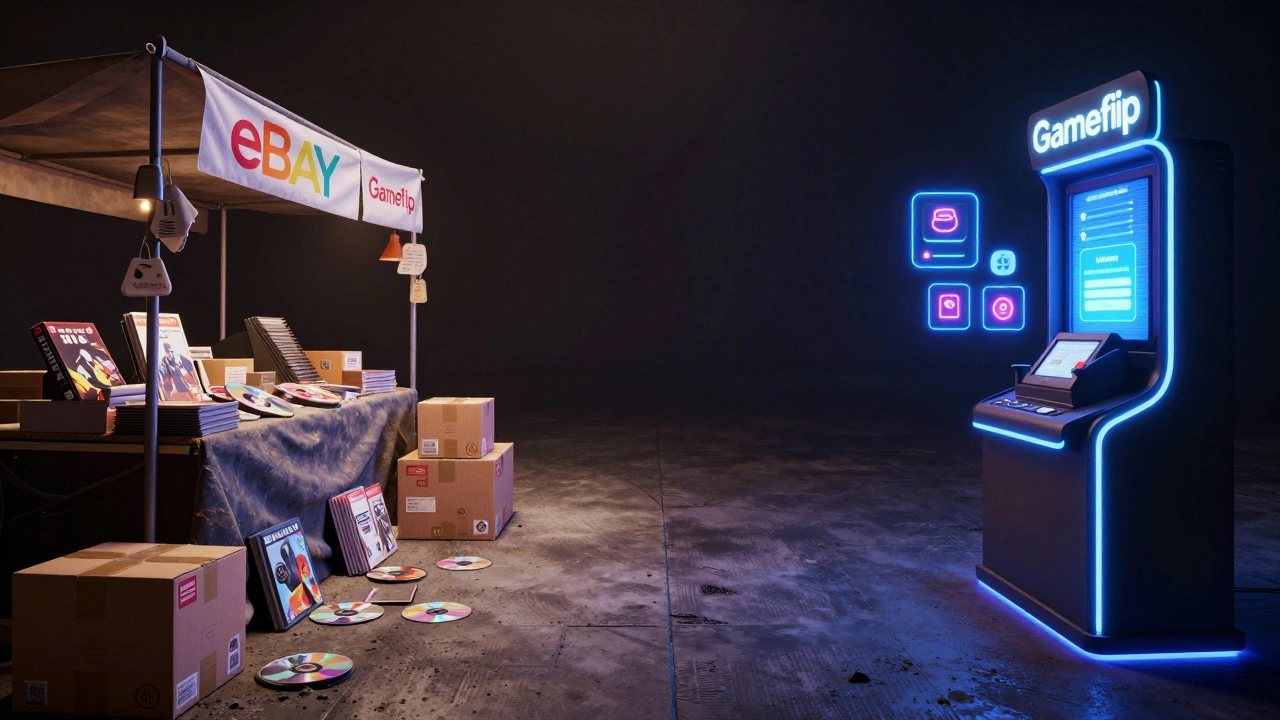
Think of it this way: eBay is the flea market. Gameflip is the specialty shop. If you’re selling a used copy of Super Mario Bros. in great condition, eBay might get you more money. But if you’re selling a $5 digital item, Gameflip is the only one that makes it worth your time.
Who’s It Really For?
If you’re selling a few games a year - maybe clearing out your closet - eBay might feel familiar. You’ve used it before. You know how to take photos. You’ve dealt with buyers. But if you’re serious about turning your gaming collection into cash, Gameflip’s design makes more sense. It removes the friction. No shipping headaches. No payment surprises. No listing limits. Just plug in your code, print a label, and get paid.
High-volume sellers? eBay’s 50-item monthly free listing limit becomes a problem. Gameflip has no cap. Sell 200 games a month? No extra fees. Sell 100 digital codes? Still just 10% total. That’s why many resellers use both: list high-value physical items on eBay, and dump low-value digital ones on Gameflip.
And don’t forget the alternatives. Swappa has no fees on items under $50. Trade4Cash gives you free shipping on orders over $10. Amazon’s trade-in program pays cash for games but not codes. Each has a sweet spot. But for a mix of physical and digital - especially if you’re selling often - Gameflip’s all-in-one model is hard to beat.
Real Numbers: A Side-by-Side Example
Let’s say you’re selling a $40 digital game code. Here’s what you’d actually walk away with:
| Platform | Transaction Fee | Shipping Cost | Payment Processing | Net to Seller |
|---|---|---|---|---|
| eBay | $4.00 (10%) | $4.50 (average) | $1.40 (PayPal) | $30.10 |
| Gameflip | $4.00 (10% total) | $0.00 (included) | $0.00 (no PayPal) | $36.00 |
Gameflip leaves you with $6 more. And that’s before you factor in time. On eBay, you spend 20 minutes listing, 10 minutes packing, 15 minutes tracking, and then wait 18 days for a buyer. On Gameflip? 3 minutes to list, 5 minutes to print a label, and you’re done. The time savings alone are worth it.
What’s the Catch?
Gameflip isn’t perfect. Its buyer pool is smaller than eBay’s. If you’re selling a rare, high-value item - say, a sealed Super Mario 64 - eBay might get you $200. Gameflip? Maybe $150. That’s because eBay has millions of casual buyers browsing every day. Gameflip has tens of thousands of gamers - focused, but fewer.
And if you hate crypto or digital wallets, Gameflip’s payout options might feel limiting. Payoneer and Skrill aren’t as familiar as PayPal. You need to set up an account. But if you’re okay with that, the trade-off is worth it: faster sales, lower hidden costs, and a platform built for your stuff.
eBay’s strength is volume. Gameflip’s strength is simplicity. One is a giant marketplace. The other is a tool made for gamers who want to turn unused digital items into cash without the hassle.
Which platform gives more money for a $50 physical game?
eBay usually does. Because it has a larger audience, buyers are willing to pay more for rare or collectible physical games. Gameflip’s buyer pool is smaller and more focused on digital items, so you might get less for a physical game, even if it’s in great condition. But if you factor in eBay’s shipping and payment fees, the difference shrinks. For a $50 game, you might net $40 on eBay after fees, and $42 on Gameflip after its 10% fee - so Gameflip can sometimes win, even on physical items.
Can I sell digital game codes on eBay?
Yes, but it’s risky. eBay doesn’t have a built-in system for delivering digital codes. Buyers often ask for proof, and if you can’t provide it quickly, they’ll cancel or file a claim. Many sellers get flagged for "item not as described" because digital codes are hard to verify. Gameflip handles this automatically - it holds the code until the buyer confirms receipt. That’s why most sellers avoid listing codes on eBay unless they’re confident in their delivery method.
Why did Gameflip drop PayPal?
PayPal’s dispute policies are heavily weighted toward buyers, and Gameflip’s model relies on trust between buyer and seller. With digital items, chargebacks are common. PayPal often sides with buyers even when the seller did everything right. Gameflip switched to payment methods like Payoneer and Skrill that give sellers more control. They also added crypto options like USDC to stay ahead of Web3 trends in gaming.
Is Gameflip safe for selling digital items?
Yes. Gameflip holds your digital item in escrow until the buyer confirms receipt. They verify codes before releasing funds. If a buyer claims they didn’t get the code, Gameflip investigates and usually sides with the seller. This is much more secure than sending a code via email on eBay, where disputes are harder to resolve.
Should I use both eBay and Gameflip?
Yes, if you have a mix of items. List high-value physical games (over $50) on eBay to reach more buyers. Use Gameflip for digital codes, low-value games, and anything under $50. This strategy maximizes both your reach and your net profit. Many top sellers use this exact approach - it’s not about choosing one over the other. It’s about using the right tool for the job.